What Is Stage 0?
A full-day, validation-only hackathon where nobody builds anything. Teams compete on the strength of their evidence that a problem is real, painful, and venture-scale.
- By
- Sylvester Mobley
- Zero Vector
- Published
- July 27, 2026
- Revised
- Not revised
- Reading
- 8 min read
- Validation
- Problem Validation
- Hackathon
- Philippines
- Founder Capability
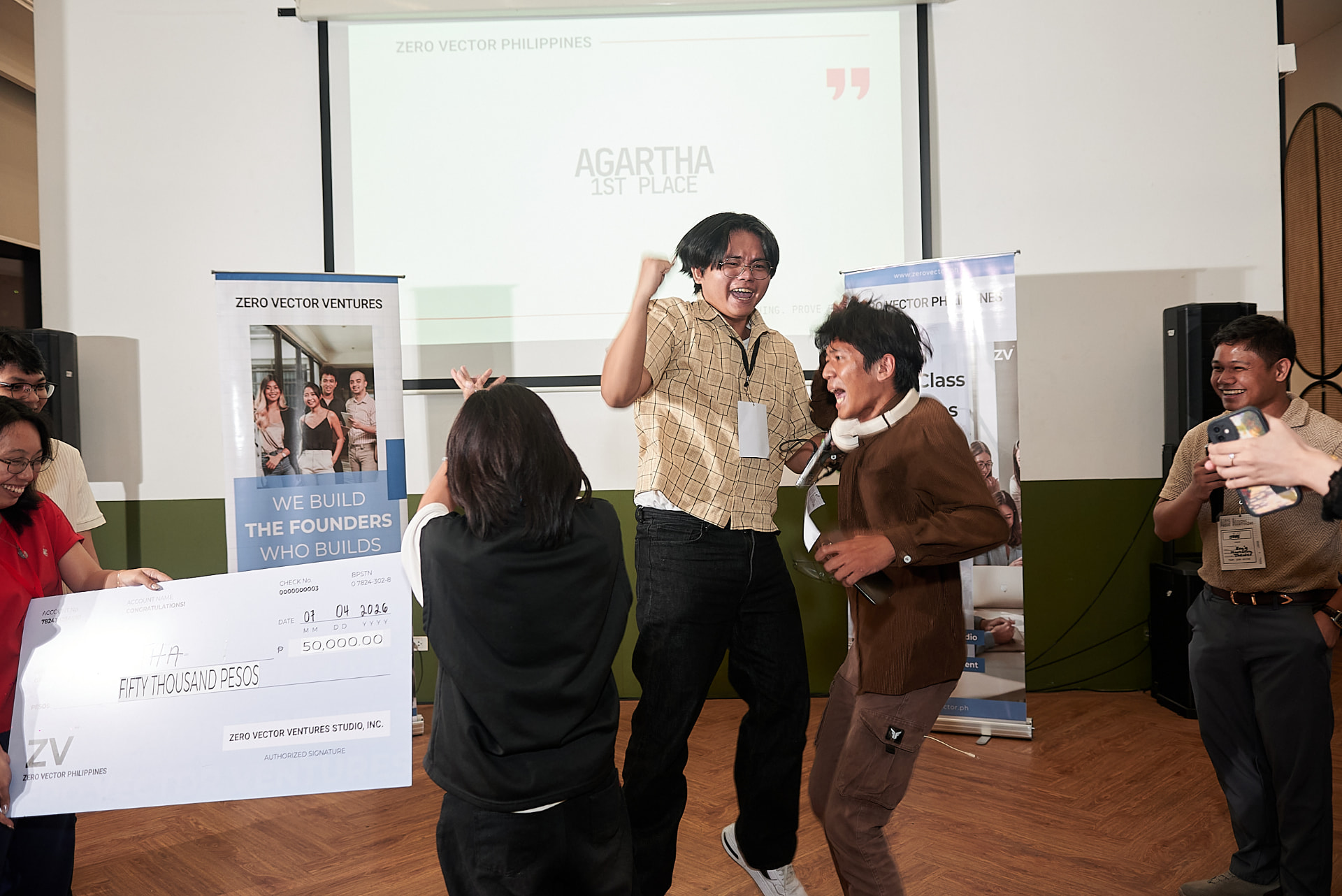
Stage 0 is a full-day, validation-only hackathon where, instead of building, participants identify problems and conduct validation research to make the most credible case possible to the judges that they have identified a real problem that is significant to the people who experience it and has a venture-scale market.
What Is Stage 0?
- Definition · Stage 0
- A full-day competition in which teams are judged entirely on the quality of the problems they identify and the validation evidence they gather — not on anything they build.
Stage 0 currently runs quarterly in Manila, Philippines.
Why Host a Hackathon Where No One Builds Anything?
Recent startup post-mortems conducted by CB Insights continue to show that poor product-market fit is a recurring underlying cause of failure. Stage 0 is designed to help participants challenge problem and market assumptions before they begin building.
We have found that:
- The problem founders often face isn't building; it's building the right thing to solve the right problem, for the right people.
- It is common for founders to build before they have enough evidence to justify building.
- Founders often build based on unvalidated ideas, then anchor to those ideas.
- While problem validation is one of the most important things early-stage founders should do, it is also one of the most commonly overlooked and poorly executed.
- Traditional startup programs and hackathons encourage founders to build, but not to ask if what they are building should be built.
- Pitch competitions reward founders for being polished and good at presentations, not for determining whether they have an actual venture-scale problem that's painful or not.
We believe many of the most important aspects of building a startup aren't visible, exciting, or sexy. This causes founders to prioritize the more visible work like building. This also results in program providers prioritizing the more visible activities such as demo days and pitch competitions. You are then left with founders who, in some cases, have spent years attempting to build startups without ever developing the core founder capabilities needed in areas such as problem validation, user research, and making continue-or-kill decisions. However, these founders have spent years cycling through numerous accelerators, incubators, hackathons, and pitch competitions.
We want to help founders begin developing the core capabilities necessary for success. We want founders to learn how to conduct rigorous problem validation to determine whether they've identified a problem worth building a solution for before they build anything. We want to push founders to embrace the non-sexy, often boring parts of building an early-stage startup that will play a significant role in whether it succeeds or fails.
We reward founders who are good at asking “Should I build this?” — not “Can I build this?”
How Does Stage 0 Work?
Over the course of 12 hours, participants get to know each other, form teams, work with their teams to identify problems, and conduct validation research. The competition portion of the hackathon itself is broken into two rounds.
- Step 01Form teams
Participants arrive as individuals, meet one another, and self-organize into teams for the day.
- Step 02Round 1 — identify and define
Teams identify and define multiple problems and begin initial research to determine which problems they believe can make it through round 2 validation.
- Step 03Round 1 judging
Each team presents the one problem they believe has the greatest potential and is judged by the panel.
- Step 04Cut to six teams
Only six teams move from round 1 to round 2. All other teams are eliminated.
- Step 05Round 2 — validation research
The six remaining teams spend the rest of the day gathering as much evidence as they can that the problem is real, extremely significant to the people impacted by it, and attached to a large market.
- Step 06Final judging
Teams present their validation work and are assessed on the strength and quality of their evidence.
Round 1 presentations are judged on the clarity and coherence of the problem, the quality of the initial evidence used to justify moving the problem to validation instead of killing it, the rationale used to determine what would have caused them to kill the problem, and their ability to identify the remaining uncertainty and riskiest assumptions with their problems.
Round 2 ends with the six remaining teams presenting their validation work to the judges, who assess the strength and quality of their evidence, their ability to explicitly identify the assumptions that needed to be validated, and their ability to update their beliefs as they conducted validation.
Stage 0 Prizes
| First place | ₱50,000 |
|---|---|
| Second place | ₱30,000 |
| Third place | ₱10,000 |
Past Stage 0 Winners
April 2026 — Stage 0 Competition
- First place: Ma. Christina Manalo, Jomari Angel Jacinto
- Second place: Christine Joy Nañola
- Third place: Raphael Paulo Alon, Lawrence Panes
July 2026 — Stage 0 Competition
- First place — Agartha: Jihad Fariq Tejam, Emiel Benedict Jane, Dianne Boholst
- Second place — GWP: John Andrei Nañola, Justin Loui Sy, Erielle Flores, Grace Kato
- Third place — CacheMe: Franchezca Banayad, Princess Mae Sanchez, Mariano Luiz King, Racehl Gio Acupan
Past Stage 0 Datapoints
| April 2026 — applicants | 95 |
|---|---|
| April 2026 — participants | 45 |
| July 2026 — applicants | 141 |
| July 2026 — participants | 67 |

Co-Founder & CEO, Zero Vector Ventures
Sylvester is co-founder and CEO of Zero Vector Ventures, leading strategy and innovation. With over 20 years in technology and startups, he brings deep expertise in early-stage validation and the technical, design, and product challenges founders face.
Read full bioRead next.
- Article · Validation
Understanding Falsifiable Tests
A working definition of falsifiable tests, the components that make them rigorous, a template for structuring them, and a real-world example.
10 min read - Article · Validation
What Is Product-Market Fit
A working definition of product-market fit, the history behind it, and the six conditions every venture-scale company must satisfy.
14 min read - Article · Venture Building
Why We Focus on Product
A working definition of product, why it sits upstream of GTM, sales, and engineering, and why Zero Vector treats it as the core driver of startup success.
9 min read - Commentary · Ecosystems
Acceleration Saturation
Accelerator-like programs have outgrown founder supply in many ecosystems, producing motion without progress and visibility without resilience.
11 min read